Think about, if you’ll, a world the place your app’s notifications gracefully slide up from the underside, providing selections and data with out disrupting the person’s stream. This, expensive mates, is the magic of the backside alert dialog android. Overlook these clunky, screen-hogging pop-ups of yesteryear! We’re speaking a couple of modern, fashionable method that prioritizes person expertise. This is not nearly code; it is about crafting an intuitive and pleasant interplay.
We’ll be exploring all the things from the basics to superior methods, reworking your app right into a symphony of usability and visible enchantment. Put together to embark on a journey that can elevate your Android improvement abilities to new heights, one elegant dialog at a time.
The journey will begin by unraveling the essence of the underside alert dialog, understanding its goal, and appreciating its benefits. We’ll discover the situations the place these dialogs really shine, like providing contextual actions or offering fast entry to important settings. Then, we’ll check out the basics of UI/UX design, guaranteeing that your dialogs usually are not solely useful but in addition visually interesting and user-friendly.
From there, we’ll dive deep into the technical facets. We’ll navigate the implementation utilizing Materials Parts, mastering customization, and getting hands-on with the code, crafting your dialogs with precision. We may also discover the creation of customized views, permitting you to construct dialogs that completely match your app’s distinctive persona.
Subsequent, we’ll enterprise into the realm of person interplay, understanding learn how to deal with button clicks, textual content enter, and different UI parts inside your dialogs. We’ll then delve into the artwork of customization, exploring colours, fonts, and animations to create a dialog that is each useful and visually gorgeous. Information integration and show would be the focus, the place you will discover ways to current info inside your dialogs, pulling knowledge from varied sources and integrating RecyclerViews for displaying lists of things.
For the adventurous, we’ll then discover superior methods, together with customized animations and sophisticated layouts. Lastly, we’ll cowl accessibility concerns, greatest practices, and optimization, guaranteeing that your dialogs usually are not solely lovely but in addition accessible and performant. And to wrap all of it up, we’ll evaluate the underside alert dialog with different dialog sorts, so you can also make knowledgeable selections about one of the best method in your app.
Introduction to Backside Alert Dialog in Android
Let’s dive into the world of Android dialogs, particularly the Backside Alert Dialog. This UI factor is a contemporary tackle the normal alert dialog, providing a extra user-friendly and visually interesting expertise. It is all about offering info and getting person enter in a method that feels pure and intuitive throughout the context of your app.This method subtly shifts the person’s focus with out totally interrupting their workflow, a big improve over the typically jarring interruption of a typical dialog.
Consider it as a well mannered notification that does not scream for consideration however nonetheless ensures the person would not miss necessary particulars or the chance to take motion.
Idea and Function
The Backside Alert Dialog in Android is actually a dialog that seems from the underside of the display. Its major goal is to current info or choices to the person in a non-intrusive method. Not like conventional dialogs that seem within the middle of the display and infrequently require dismissing earlier than persevering with, the Backside Alert Dialog permits the person to keep up context with the content material behind it.
It is designed to be simply accessible and shortly dismissible, offering a seamless person expertise.
Benefits Over Conventional Dialogs
Some great benefits of utilizing a Backside Alert Dialog are quite a few, enhancing person interplay and general app usability.
- Improved Person Expertise: Backside Alert Dialogs are much less disruptive than conventional dialogs. They permit customers to keep up context with the app’s content material, enhancing the stream of interplay.
- Enhanced Visible Enchantment: They typically have a cleaner, extra fashionable design, contributing to a extra aesthetically pleasing interface. The delicate animation of sliding up from the underside can really feel extra elegant than a sudden pop-up.
- Higher Reachability: They’re sometimes simpler to achieve on bigger screens, as they seem on the backside the place customers’ thumbs typically naturally relaxation.
- Adaptability: They will adapt to totally different display sizes and orientations extra successfully, sustaining a constant person expertise.
Most well-liked Eventualities
Contemplate these situations to find out when a Backside Alert Dialog is the proper match in your app:
- Affirmation of Actions: When confirming a person motion, akin to deleting an merchandise or submitting a kind. The dialog can present choices like “Affirm” and “Cancel”.
- Displaying Extra Info: When presenting further particulars or choices associated to a selected merchandise or motion. As an illustration, displaying sharing choices for a photograph or article.
- Presenting a Checklist of Decisions: When providing a listing of choices for the person to pick out, like sorting preferences or filter standards.
- Contextual Actions: For fast actions associated to the present display context, like enhancing a profile or including a brand new merchandise.
As an illustration, contemplate a music app. When a person faucets the “…” icon subsequent to a music, a Backside Alert Dialog might seem with choices like “Add to Playlist,” “Share,” and “View Artist Data.” This retains the person within the context of the music participant and prevents them from shedding their place.
Primary UI/UX Ideas
When designing a Backside Alert Dialog, conserving a number of key UI/UX rules in thoughts will vastly enhance its effectiveness and person satisfaction.
- Readability and Conciseness: Hold the content material of the dialog transient and simple to grasp. Keep away from overwhelming the person with an excessive amount of info or too many choices.
- Visible Hierarchy: Use visible cues like font measurement, colour, and spacing to information the person’s eye and spotlight a very powerful info.
- Actionable Buttons: Make sure that the buttons are clearly labeled and simply distinguishable. The first motion ought to stand out.
- Contact Goal Measurement: Guarantee that buttons and interactive parts are giant sufficient for customers to simply faucet on, particularly on smaller screens.
- Dismissibility: Present a simple method for the person to dismiss the dialog, akin to a “Cancel” button or tapping outdoors the dialog space.
- Animation and Transitions: Use easy animations, akin to sliding up from the underside, to make the dialog really feel extra built-in with the app’s general design.
Contemplate a meals supply app. When a person faucets on a restaurant merchandise, a Backside Alert Dialog might present up, permitting them to regulate the amount, view merchandise particulars, or add it to the cart. The dialog needs to be clear, concise, and simple to navigate, with a transparent name to motion (e.g., “Add to Cart”).
Implementation Strategies: Backside Alert Dialog Android
Let’s dive into how one can construct a very customized Backside Alert Dialog, shifting past the usual templates. We’ll discover crafting these dialogs from scratch utilizing customized views, permitting for max flexibility and a design that is uniquely yours. This method is ideal for situations the place you want a extremely particular appear and feel, or complicated interactive parts that transcend easy textual content and buttons.
Utilizing Customized Views
Constructing a customized Backside Alert Dialog with customized views offers you full management over its look and conduct. This technique entails creating your individual format and look at parts, then integrating them into the dialog’s construction. It is like having a clean canvas the place you may paint any design you may think about.To start out this journey, observe these steps:
- Create a Customized Structure: That is the place the magic occurs. You may outline the visible construction of your dialog.
- Construct the Customized View Class: Create a category that extends `LinearLayout`, `RelativeLayout`, or any appropriate view group to handle the customized format and person interactions.
- Inflate the Structure: In your customized view’s constructor, inflate the format you created in step 1 utilizing `LayoutInflater`.
- Implement Person Interplay: Inside your customized view class, add logic to deal with button clicks, textual content enter, and different person interactions.
- Combine into Backside Sheet Dialog: Create a `BottomSheetDialog` and add your customized view to it.
Making a Customized Structure for Dialog Content material
The customized format is the blueprint in your dialog’s look. It is an XML file the place you outline the views that can make up your dialog: textual content, buttons, enter fields, pictures, and extra. This provides you the liberty to craft a dialog that completely matches your app’s model and performance.To design your customized format, contemplate these key parts:
- Root View: Begin with a root view like `LinearLayout` or `RelativeLayout` to arrange the opposite views. Consider it because the container that holds all the things.
- Content material Views: Add views like `TextView` for textual content, `EditText` for enter, and `ImageView` for pictures. Place them fastidiously to create the specified format.
- Button Views: Use `Button` or `MaterialButton` for interactive parts. Place them strategically, typically on the backside of the dialog.
- Styling: Apply kinds and themes to offer your dialog a cultured look. Use attributes like `android:textColor`, `android:background`, and `android:padding` to customise the looks.
- Constraints: If utilizing `ConstraintLayout`, use constraints to outline how views are positioned relative to one another and the dad or mum format. This ensures that the format adapts effectively to totally different display sizes.
For instance, think about designing a dialog to substantiate a person’s deletion of an merchandise. The format would possibly embody a `TextView` for the affirmation message, two `MaterialButton` parts labeled “Cancel” and “Delete,” and maybe an `ImageView` displaying an icon for emphasis. The `TextView` and the buttons could be positioned throughout the format, styled with acceptable colours and fonts. The “Cancel” button would sometimes be positioned to the left, and the “Delete” button on the suitable, offering clear choices for the person.
Dealing with Person Interactions throughout the Customized View
Person interplay is on the coronary heart of any dialog. It’s essential to equip your customized view with the logic to reply to person actions, akin to button clicks and enter. This entails organising occasion listeners and dealing with the corresponding actions.To successfully deal with person interactions, observe these key steps:
- Discover Views: In your customized view class, discover the views that you just need to work together with, akin to buttons and enter fields, utilizing `findViewById()`.
- Set Click on Listeners: For buttons, set `OnClickListener` to reply to click on occasions. Contained in the listener, write the code that ought to execute when the button is clicked.
- Deal with Enter Fields: In case your dialog comprises enter fields, akin to `EditText`, you may retrieve the entered textual content utilizing strategies like `getText().toString()`.
- Talk with the Dialog: You might want to speak the person’s actions to the dialog itself. This may be completed by interfaces or callbacks. For instance, when the person clicks “Delete,” you’d set off a callback to the exercise or fragment that created the dialog to carry out the deletion motion.
- Validation: In case your dialog consists of enter fields, validate the person’s enter to make sure it meets the required standards. Present suggestions to the person if the enter is invalid.
As an illustration, contemplate a customized view with “Affirm” and “Cancel” buttons. The “Affirm” button’s `OnClickListener` would possibly:
Retrieve the person’s enter from an `EditText` subject.
Validate the enter (e.g., verify if a required subject is stuffed).
If the enter is legitimate, set off a callback to the dad or mum exercise to carry out an motion (e.g., save knowledge).
If the enter is invalid, show an error message.
The “Cancel” button would merely shut the dialog. This structured method ensures a responsive and user-friendly expertise.
Dealing with Person Interactions and Actions

The Backside Alert Dialog, in its modern and unobtrusive design, is not only a fairly face; it is a dynamic interface prepared to have interaction along with your customers. Successfully managing these interactions is essential for making a easy and intuitive person expertise. This part dives into the guts of person engagement throughout the Backside Alert Dialog, exploring the assorted methods customers work together and the way you, because the developer, can reply to their actions.
Button Click on Dealing with
Buttons are the workhorses of the Backside Alert Dialog, offering customers with clear pathways to take motion. Dealing with button clicks is a elementary facet of the dialog’s performance. This entails listening for clicks, figuring out the button pressed, after which executing the corresponding logic.
- Figuring out Buttons: Buttons are sometimes recognized by their distinctive IDs. These IDs are assigned within the format XML file the place the dialog’s content material is outlined. For instance:
- Setting Click on Listeners: As soon as the dialog is inflated and displayed, it’s essential connect click on listeners to every button. That is often completed throughout the `onCreateView()` technique of the fragment or the dialog’s creation technique. The `setOnClickListener()` technique is used for this goal.
- Responding to Clicks: Contained in the `onClick()` technique, you will place the code that ought to run when the button is pressed. This might contain updating knowledge, dismissing the dialog, or navigating to a different display.
- Instance State of affairs: Think about a Backside Alert Dialog confirming a person’s motion, like deleting a file. Clicking the “Delete” button would set off code that really deletes the file after which dismisses the dialog.
<Button android:id="@+id/positiveButton" ... />
Right here, the button has the ID “positiveButton”.
  Button positiveButton = dialog.findViewById(R.id.positiveButton);

  positiveButton.setOnClickListener(new View.OnClickListener()

   @Override

   public void onClick(View v)

    // Code to execute when the optimistic button is clicked
);
Textual content Enter Dealing with
Typically, a Backside Alert Dialog wants to collect info from the person. That is the place textual content enter fields come into play. Dealing with textual content enter entails retrieving the textual content entered by the person and processing it accordingly.
- Figuring out Enter Fields: Textual content enter is usually dealt with utilizing `EditText` views. These are additionally recognized by their IDs within the format XML.
- Retrieving Textual content: Inside the button’s `onClick()` technique (or one other related occasion), you may retrieve the textual content entered by the person utilizing the `getText()` technique. Keep in mind to transform the `Editable` object returned by `getText()` to a `String`.
- Validating Enter: Earlier than processing the enter, it is important to validate it. This would possibly contain checking for empty fields, guaranteeing the right format, or verifying the enter towards a algorithm. As an illustration, for those who’re asking for an e-mail handle, you’ll validate that the entered textual content matches the e-mail format utilizing common expressions.
- Instance State of affairs: A Backside Alert Dialog would possibly immediate the person to enter a brand new password. The code would then retrieve the password, validate it (e.g., verify for minimal size and complexity), and if legitimate, put it aside.
<EditText android:id="@+id/userInput" ... />
  EditText userInput = dialog.findViewById(R.id.userInput);

  String inputText = userInput.getText().toString();
Dealing with Different UI Parts
In addition to buttons and textual content enter, Backside Alert Dialogs can embody different UI parts, akin to checkboxes, radio buttons, and sliders. Every of those parts requires particular dealing with to seize the person’s selections.
- Checkboxes and Radio Buttons: These parts are used to permit customers to pick out a number of choices. You must decide the state of those parts (checked or unchecked) when the person interacts with the dialog.
- Sliders (SeekBar): Sliders are used for choosing a numerical worth inside a variety. You may must retrieve the present worth of the slider when the person interacts with it.
- Instance State of affairs: A Backside Alert Dialog for configuring notification settings would possibly embody checkboxes for various notification sorts and a slider for adjusting the quantity.
  CheckBox checkBox = dialog.findViewById(R.id.myCheckbox);

  boolean isChecked = checkBox.isChecked();
  SeekBar seekBar = dialog.findViewById(R.id.mySeekBar);

  int sliderValue = seekBar.getProgress();
Speaking Person Decisions
The final word objective of dealing with person interactions is to speak the person’s selections again to the calling exercise or fragment. This allows the calling element to react to the person’s selections.
- Utilizing Interfaces (Callbacks): The commonest method is to make use of an interface. You outline an interface in your dialog with strategies comparable to the person’s actions. The calling exercise or fragment implements this interface and gives the logic to deal with the person’s selections.
- Passing Information By means of Arguments: It’s also possible to go knowledge instantly again to the calling element by arguments. That is appropriate for easy circumstances the place the information to be returned is restricted.
- Utilizing Consequence Codes: One other method is to make use of consequence codes, just like how actions return outcomes. The dialog units a consequence code and passes any related knowledge again to the calling element.
- Instance State of affairs: Contemplate a Backside Alert Dialog for submitting a kind. The dialog makes use of an interface to inform the calling exercise when the person submits the shape, passing the entered knowledge again as arguments. The exercise then makes use of this knowledge to replace the UI or ship it to a server.
  // Contained in the Backside Alert Dialog

  public interface NoticeDialogListener

   void onDialogPositiveClick(String userInput);

   void onDialogNegativeClick();
// Exercise/Fragment that creates the dialog
public class MyActivity implements NoticeDialogListener
@Override
public void onDialogPositiveClick(String userInput)
// Deal with the person's enter
Customization Choices
Let’s face it, no one desires a boring dialog. Fortunately, Android’s Backside Alert Dialog gives a plethora of customization choices to make it pop, suit your app’s aesthetic, and usually be a pleasure to behold. We’re speaking all the things from a delicate colour tweak to a full-blown animation extravaganza. Able to ditch the drab and embrace the fab? Let’s dive in!
Look Customization, Backside alert dialog android
The visible enchantment of your Backside Alert Dialog is paramount. Fortuitously, Android gives in depth instruments to tailor its look to your coronary heart’s content material.This is how one can take management:
- Colours: That is the place the magic really begins. You may modify the background colour, textual content colour, button colours, and even the colour of the divider strains. Consider it as portray a canvas. You may use themes, kinds, and colour assets in your `res/values/` listing to outline these. As an illustration, you might change the background of your dialog to a chilled shade of blue (#ADD8E6) or make the textual content pop with a vibrant contrasting colour.
- Fonts: Typography is crucial. Select fonts that complement your app’s general design. You may specify font households, sizes, and kinds (daring, italic, and so on.). Customized fonts are additionally supported, permitting you to make use of fonts that completely match your model’s identification. For instance, for those who’re constructing an app for a espresso store, you would possibly use a pleasant, handwritten-style font for the dialog’s title and a clear, readable font for the physique textual content.
- Shapes and Corners: Whereas the Backside Alert Dialog typically has an oblong form, you may management the roundedness of its corners. That is often managed by the dialog’s background, outlined in a drawable useful resource. Experiment with totally different nook radii to create a contemporary, modern look or a softer, extra approachable really feel.
- Padding and Margins: Tremendous-tune the spacing throughout the dialog to make sure that parts are well-balanced and simple to learn. Modify padding round textual content and buttons, and margins to manage the spacing between totally different parts. This impacts the general visible concord.
- Illustrative Instance: Think about designing a Backside Alert Dialog for a buying app. You can set the background to a lightweight grey (#F0F0F0), use the app’s major colour (maybe a vibrant orange) for the motion buttons, a clear sans-serif font for the textual content, and rounded corners for a contemporary look.
Conduct Customization
Past aesthetics, the way in which your Backside Alert Dialog behaves is essential for a easy person expertise. Android gives sturdy instruments to manage how the dialog seems and disappears, permitting for partaking and intuitive interactions.Contemplate these facets:
- Opening Animations: The entry animation units the tone. Choices vary from easy fades and slides to extra complicated transitions. Select an animation that aligns with the context of the dialog. A slide-up animation is frequent, however a fade-in could be extra appropriate for a much less intrusive alert.
- Closing Animations: Equally, the exit animation ought to present a swish departure. Choices embody fade-out, slide-down, or a scale-down impact. The closing animation ought to really feel pure and never disrupt the person’s stream.
- Animation Timing: The pace of animations is important. Too quick, and the animation could be missed; too sluggish, and it could possibly really feel sluggish. Experiment with totally different durations (e.g., 200ms, 300ms, 400ms) to search out the candy spot.
- Animation Kinds: You may create customized animations or use predefined ones offered by the Android system. Customized animations contain defining animation assets (e.g., `slide_up.xml`) that specify how parts transfer, scale, or change their opacity over time.
- Instance Animation Implementation: To implement a slide-up animation, you’d outline an animation useful resource like `slide_up.xml`:
<set xmlns:android="http://schemas.android.com/apk/res/android">
    <translate
        android:fromYDelta="100%"
        android:toYDelta="0%"
        android:period="300" />
</set>
This XML defines a translation animation that strikes the dialog from the underside of the display (100% off-screen) to its closing place (0% off-screen) over 300 milliseconds. Then, you’d apply this animation when the dialog is proven.
Information Integration and Show
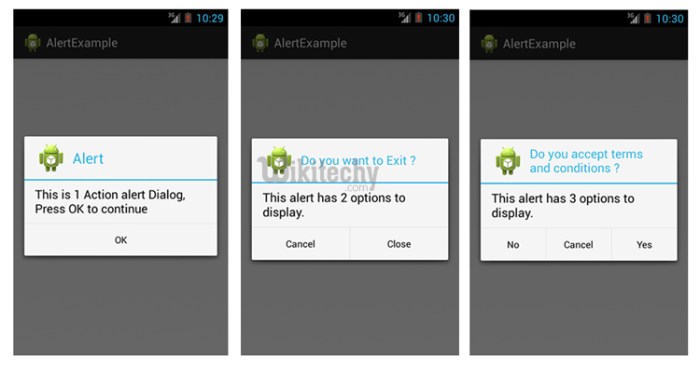
Integrating knowledge seamlessly and displaying it successfully inside a Backside Alert Dialog is essential for offering customers with related info in a concise and accessible method. This part will delve into the assorted strategies for reaching this, masking knowledge sources, show methods, and sensible implementation particulars.
Displaying Information: Textual content, Photographs, and Lists
The Backside Alert Dialog’s versatility lies in its potential to current numerous knowledge sorts. You may tailor the presentation to swimsuit the precise info you are conveying.
Textual content is essentially the most elementary knowledge kind, used for displaying titles, descriptions, and any textual content material. Photographs improve visible enchantment and assist customers shortly grasp info. Lists, significantly, turn into indispensable when coping with a number of gadgets or knowledge factors.
This is learn how to incorporate these parts:
- Textual content: Use `TextView` parts inside your dialog’s format. Set the textual content content material dynamically utilizing strategies like `setText()`. Think about using totally different textual content kinds (daring, italics) or sizes to emphasise key info.
- Photographs: Make the most of `ImageView` parts. Load pictures from varied sources (native storage, community) utilizing libraries like Glide or Picasso for environment friendly picture loading and caching.
- Lists: Make use of `ListView` (for less complicated lists) or `RecyclerView` (for extra complicated lists with dynamic knowledge and environment friendly efficiency). The `RecyclerView` is mostly most well-liked for its flexibility and efficiency advantages, particularly when coping with giant datasets.
Information Sources: Native Storage and Community Requests
Information originates from varied places, and your Backside Alert Dialog wants to have the ability to entry and show it successfully. This entails understanding learn how to fetch knowledge from totally different sources.
- Native Storage: Native storage encompasses knowledge saved on the system itself, akin to SQLite databases, shared preferences, or information.
For instance, to retrieve knowledge from a SQLite database, you’ll:
- Create a database helper class to handle database interactions.
- Open a database connection.
- Execute a SQL question to fetch the specified knowledge.
- Iterate by the outcomes and populate your views (e.g., `TextViews` or `RecyclerView` gadgets) throughout the Backside Alert Dialog.
- Community Requests: When knowledge resides on a server, you will must make community requests (e.g., utilizing Retrofit, Volley, or OkHttp).
Right here’s a common workflow:
- Outline an API interface (utilizing Retrofit, as an example) to specify the endpoints and knowledge codecs.
- Make an asynchronous community name to fetch knowledge from the server (e.g., utilizing `enqueue` in Retrofit).
- Parse the JSON or XML response.
- Populate the UI parts of your Backside Alert Dialog with the retrieved knowledge. Keep in mind to deal with community errors gracefully (e.g., show an error message to the person).
Integrating RecyclerView in Backside Alert Dialog
The `RecyclerView` is the workhorse for displaying lists in Android purposes, and it is significantly beneficial inside a Backside Alert Dialog. It gives environment friendly efficiency, particularly when dealing with giant datasets. This is a information to integrating it:
- Structure Setup: In your Backside Alert Dialog’s format XML file, add a `RecyclerView` factor:
“`xml
“`
- Create an Adapter: You may want an adapter class to handle the information and bind it to the `RecyclerView`. This adapter will:
- Outline a ViewHolder class to carry references to the views inside every checklist merchandise (e.g., `TextViews`, `ImageViews`).
- Override the `onCreateViewHolder()` technique to inflate the format for every checklist merchandise.
- Override the `onBindViewHolder()` technique to bind knowledge to the views in every checklist merchandise.
- Override the `getItemCount()` technique to return the variety of gadgets within the knowledge set.
- Create a Information Mannequin: Outline an information mannequin class to symbolize the gadgets in your checklist. As an illustration, for those who’re displaying a listing of merchandise, you may need a `Product` class with properties like `title`, `description`, and `imageUrl`.
- Populate the RecyclerView: In your Backside Alert Dialog’s code:
- Discover the `RecyclerView` in your format utilizing `findViewById()`.
- Create an occasion of your adapter, passing in your knowledge set.
- Set the adapter on the `RecyclerView` utilizing `setAdapter()`.
- Set a `LayoutManager` on the `RecyclerView` (e.g., `LinearLayoutManager` for a vertical checklist, `GridLayoutManager` for a grid).
This is a simplified instance of an adapter:
“`java
public class MyAdapter extends RecyclerView.Adapter
non-public Checklist productList;
public MyAdapter(Checklist productList)
this.productList = productList;
@NonNull
@Override
public ViewHolder onCreateViewHolder(@NonNull ViewGroup dad or mum, int viewType)
View view = LayoutInflater.from(dad or mum.getContext()).inflate(R.format.product_item, dad or mum, false);
return new ViewHolder(view);
@Override
public void onBindViewHolder(@NonNull ViewHolder holder, int place)
Product product = productList.get(place);
holder.nameTextView.setText(product.getName());
// Load picture utilizing Glide or Picasso
@Override
public int getItemCount()
return productList.measurement();
public static class ViewHolder extends RecyclerView.ViewHolder
TextView nameTextView;
ImageView imageView;
public ViewHolder(@NonNull View itemView)
tremendous(itemView);
nameTextView = itemView.findViewById(R.id.productNameTextView);
imageView = itemView.findViewById(R.id.productImageView);
“`
The `product_item.xml` format would outline the construction for every checklist merchandise (e.g., a `TextView` for the product title and an `ImageView` for the product picture).
This method ensures environment friendly knowledge show, permitting customers to work together with lists of things inside your Backside Alert Dialog.
Superior Strategies
Diving deeper into the world of Backside Alert Dialogs unlocks a universe of potentialities, reworking a easy UI factor right into a dynamic and interesting person expertise. This part explores superior customization and sensible use circumstances, empowering you to create really distinctive Android purposes.
Superior Customization: Animations and Transitions
Including a touch of aptitude to your Backside Alert Dialogs elevates them from useful to unbelievable. This entails incorporating customized animations and transitions, which not solely improve visible enchantment but in addition present essential suggestions to the person, making interactions really feel smoother and extra intuitive.
- Customized Animations: Assume past the default fade-in. Contemplate slide-up animations, the place the dialog gracefully emerges from the underside of the display. Or maybe a delicate scale-up impact, giving the impression of the dialog materializing. The probabilities are limitless, restricted solely by your creativeness and the capabilities of Android’s animation framework. For instance, you might use `ObjectAnimator` to manage properties like `translationY` for a slide-up impact or `scaleX` and `scaleY` for a scaling animation.
The code would possibly look one thing like this:
“`java
ObjectAnimator slideUp = ObjectAnimator.ofFloat(dialogView, “translationY”, dialogView.getHeight(), 0f);
slideUp.setDuration(300); // milliseconds
slideUp.begin();
“`This code snippet, when utilized to the dialog’s root view (`dialogView`), animates its vertical place from under the display to its closing place, making a slide-up impact.
- Customized Transitions: Transitions outline how the dialog interacts with the remainder of the UI. Experiment with transitions that match the general aesthetic of your app. As an illustration, a Materials Design app would possibly profit from a shared factor transition, the place a selected factor within the originating view easily transforms into a component throughout the dialog.
- Animation Sources: As a substitute of hardcoding animation properties, leverage animation assets (XML information). This method enhances code readability and maintainability. You may outline animations utilizing ` `, “, “, and “ tags inside these XML information. For instance:
“`xml
“`
This XML file defines a slide-up animation. You may then apply this animation to your dialog’s view utilizing `AnimationUtils.loadAnimation(context, R.anim.slide_up)`.
- CoordinatorLayout and Animations: Utilizing a `CoordinatorLayout` because the dad or mum format in your exercise means that you can benefit from superior options like behaviors. Behaviors can be utilized to manage how views react to one another, creating refined animations and transitions. For instance, you might create a customized conduct that animates the dialog’s look based mostly on the person’s scroll place in a `RecyclerView` or `ScrollView`.
Superior Use Instances: Choice and Info Show
Past easy confirmations and alerts, Backside Alert Dialogs will be leveraged for extra complicated interactions. This part delves into examples of learn how to use them for choosing choices and presenting detailed info.
- Choice Choice Dialog: Think about a situation the place a person wants to select from a listing of choices. A Backside Alert Dialog is ideal for this. It retains the choices readily accessible with out cluttering the primary display.
Instance: Contemplate a photograph enhancing app the place a person faucets a “Crop” button. A Backside Alert Dialog seems, presenting choices like “Freeform,” “Sq.,” “16:9,” and “Unique.” Every choice, when chosen, triggers the corresponding crop performance.
That is far more user-friendly than navigating to a separate display for these choices.
- Detailed Info Show: Use Backside Alert Dialogs to supply wealthy, detailed info with out taking the person away from their present context.
Instance: In a music streaming app, tapping the “Extra Data” button subsequent to a music might show a Backside Alert Dialog. This dialog would possibly comprise the album artwork, music particulars (artist, album, launch 12 months), lyrics, and hyperlinks to associated content material.
This design retains the person engaged with out the disruption of a full-screen transition.
- Interactive Parts: Improve these dialogs with interactive parts like:
- Radio Buttons/Checkboxes: For multiple-choice choices.
- Sliders: For adjusting settings like quantity or brightness.
- Textual content Fields: For coming into customized values.
- Photographs and Movies: For richer visible experiences.
- Information Binding: Combine knowledge binding to simplify the method of populating and updating the dialog’s content material. Information binding eliminates the necessity for handbook `findViewById()` calls and makes it simpler to maintain the UI in sync with the information.
Information: Creating Backside Alert Dialogs with Complicated Layouts
Constructing a Backside Alert Dialog with complicated layouts and interactive parts requires a structured method. This information Artikels the important thing steps and concerns.
- Outline the Structure: Design the dialog’s format utilizing XML. Think about using a `LinearLayout`, `RelativeLayout`, or `ConstraintLayout` to rearrange the assorted parts. The selection of format is determined by the complexity and the specified association of your parts. For complicated layouts, `ConstraintLayout` is mostly most well-liked for its flexibility and efficiency advantages.
- Create the Dialog View: Inflate the format you outlined within the earlier step inside your dialog’s `onCreateView()` technique (if utilizing a customized `DialogFragment`) or when constructing the dialog’s content material.
Instance:
“`java
// Inside a customized DialogFragment
@Override
public View onCreateView(LayoutInflater inflater, ViewGroup container, Bundle savedInstanceState)
View view = inflater.inflate(R.format.custom_dialog_layout, container, false);
// …(discover views, set listeners, and so on.)
return view;“`
Right here, `custom_dialog_layout` is your XML format file.
- Implement Interactive Parts: Deal with person interactions with the weather throughout the dialog. Set `OnClickListener` for buttons, `OnItemSelectedListener` for dropdowns, and so on. Make certain the interactions are acceptable and per the dialog’s goal.
- Deal with Information Integration: Populate the dialog with knowledge out of your app’s knowledge sources. This would possibly contain fetching knowledge from a database, API, or native storage. Use knowledge binding to simplify the method.
- Customise Look: Customise the dialog’s look to match your app’s design language. This consists of setting the background colour, textual content kinds, and different visible attributes. Think about using themes and kinds to keep up consistency throughout your utility.
- Add Animations and Transitions: Implement customized animations and transitions to reinforce the person expertise, as described within the “Superior Customization” part. Think about using animation assets (XML) for higher group.
- Handle State: In case your dialog comprises complicated interactions or knowledge, you would possibly must handle its state. This might contain saving and restoring the state of enter fields, chosen choices, and so on. Use `onSaveInstanceState()` and `onViewStateRestored()` (if utilizing a `DialogFragment`) to protect the dialog’s state throughout configuration adjustments (e.g., display rotation).
- Take a look at Completely: Take a look at your Backside Alert Dialog totally on totally different units and display sizes to make sure it capabilities appropriately and appears good. Pay shut consideration to accessibility and value. Think about using UI testing frameworks to automate testing.
Accessibility Concerns
Let’s speak about making your Backside Alert Dialogs welcoming to everybody. It is not nearly aesthetics; it is about guaranteeing your app is usable and pleasurable for all customers, together with these with disabilities. Consider it as constructing a home: you would not simply construct a reasonably facade, you’d be certain the ramps are accessible, the doorways are broad sufficient, and the controls are simple to achieve.
This part focuses on the “ramps” and “doorways” of your Backside Alert Dialogs.
Display Reader Compatibility
Making certain display readers can successfully interpret your Backside Alert Dialog is paramount. This enables visually impaired customers to grasp the knowledge offered and work together with the dialog’s controls. Correct implementation entails offering descriptive textual content for UI parts and organizing the content material logically.
- Content material Descriptions: Each interactive factor inside your dialog, like buttons and textual content fields, wants a content material description. That is the textual content that the display reader will announce. Use the `android:contentDescription` attribute in your XML format or the `setContentDescription()` technique in your Java/Kotlin code. As an illustration, as an alternative of simply “OK,” a button may need an outline like “Affirm motion and shut dialog.”
- Labeling UI Parts: Use `android:labelFor` to affiliate labels with enter fields. This helps display readers announce the aim of every subject. If a textual content subject is for coming into a reputation, its related label ought to clearly state “Identify.”
- Logical Studying Order: The order by which parts are offered within the format dictates the order by which a display reader reads them. Guarantee a logical stream. Put the title, then the descriptive textual content, then the actions (buttons) in a transparent, easy-to-follow sequence.
- Testing with Display Readers: Essentially the most essential step is testing. Use a display reader like TalkBack (Android’s built-in display reader) to navigate your dialog. Pay attention fastidiously to the bulletins. Do they make sense? Can you full all of the meant actions?
Keyboard Navigation
Keyboard navigation is important for customers who can not use a touchscreen or choose keyboard interplay. This entails enabling focus administration and guaranteeing all interactive parts will be accessed and activated utilizing a keyboard.
- Focus Administration: Android’s system robotically handles focus in lots of circumstances, however you might must information it, particularly in complicated dialogs. Use the `android:focusable` and `android:focusableInTouchMode` attributes to manage whether or not a view can obtain focus.
- Focus Order: Set the main target order utilizing the `android:nextFocusForward` and `android:nextFocusLeft/Proper/Up/Down` attributes to direct the keyboard focus. This allows you to specify which view receives focus subsequent when the person presses the Tab key or directional keys.
- Button Activation: Make sure that buttons will be activated by urgent the Enter key or Spacebar once they have focus. That is typically dealt with robotically, however affirm it throughout testing.
- Customized View Dealing with: In the event you’re utilizing customized views, you would possibly must override the `onKeyUp()` or `onKeyDown()` strategies to deal with keyboard occasions appropriately.
Coloration Distinction and Visible Readability
Visible impairments could make it tough to understand info. Enough colour distinction and clear visible presentation are crucial for accessibility.
- Coloration Distinction Ratio: Adhere to WCAG (Internet Content material Accessibility Tips) requirements for colour distinction. Use instruments just like the WebAIM Distinction Checker to make sure ample distinction between textual content and background colours. A minimal distinction ratio of 4.5:1 is advisable for regular textual content and three:1 for big textual content.
- Font Measurement and Readability: Use a legible font measurement, ideally 16sp or bigger for physique textual content. Keep away from overly stylized fonts that could be tough to learn. Guarantee enough line spacing and letter spacing for readability.
- Keep away from Relying Solely on Coloration: Don’t use colour as the one strategy to convey info. For instance, as an alternative of simply highlighting an error message in crimson, additionally embody an icon or textual content indicating the error kind.
Implementation Examples
Let’s discover some sensible examples as an instance learn how to implement these accessibility options.
- Including Content material Descriptions:
In your XML format, you might have a button like this:
“`xml
“`This ensures the display reader pronounces the button’s goal clearly.
Or in Kotlin:
“`kotlin
val confirmButton: Button = findViewById(R.id.confirmButton)
confirmButton.contentDescription = “Affirm motion and shut the dialog”
“` - Focus Administration Instance:
For example you may have a dialog with an enter subject and a button. You may handle focus like this:
“`xml
“`This ensures that when the EditText receives focus, the person can simply transfer to the “Submit” button utilizing keyboard navigation.
- Testing with TalkBack:
Activate TalkBack in your Android system. Navigate to your Backside Alert Dialog. Pay attention fastidiously to what TalkBack pronounces. Confirm that every one parts are learn appropriately, and you may activate all buttons and work together with all enter fields. That is the final word take a look at to make sure your dialog is accessible.
Accessibility Guidelines
To make sure you do not miss any crucial steps, here is a helpful guidelines:
- Confirm content material descriptions for all interactive parts.
- Guarantee a logical studying order.
- Take a look at keyboard navigation.
- Verify colour distinction ratios.
- Use a display reader (TalkBack) for complete testing.
- Use Accessibility Scanner to determine points.
By implementing these pointers and constantly testing your Backside Alert Dialogs, you will be constructing an utility that’s not solely useful but in addition inclusive, empowering all customers to take pleasure in your app.
Greatest Practices and Optimization
Implementing Backside Alert Dialogs successfully requires consideration to element, from preliminary design to closing deployment. This part delves into the core rules for crafting performant and user-friendly dialogs, masking format optimization, knowledge dealing with, and adaptableness throughout varied system configurations. Let’s be certain your dialogs shine!
Implementing Greatest Practices
Adhering to established greatest practices is essential for creating Backside Alert Dialogs which can be each useful and pleasant for customers. This entails a multifaceted method encompassing design rules, code construction, and person expertise concerns.
- Prioritize Readability and Conciseness: Hold the dialog’s goal clear and the content material targeted. Keep away from overwhelming customers with extreme info. Every factor ought to contribute on to the person’s understanding and decision-making course of.
- Present Visible Hierarchy: Use visible cues like font sizes, colours, and spacing to information the person’s consideration. Guarantee a very powerful info stands out, permitting customers to shortly grasp the core message and actions.
- Guarantee Accessibility: Design your dialogs with accessibility in thoughts. Present ample colour distinction, help for display readers, and acceptable contact targets to cater to customers with disabilities. This promotes inclusivity and a greater person expertise for everybody.
- Use Constant UI Patterns: Keep consistency with the general app’s design language. This familiarizes customers with the interface, decreasing cognitive load and making interactions extra intuitive.
- Deal with Dismissal Gracefully: Present clear choices for dismissing the dialog, akin to “Cancel” or an in depth button. Make sure the dismissal motion aligns with the person’s expectations and would not result in surprising conduct.
Optimizing Efficiency
Efficiency optimization is significant for delivering a easy and responsive person expertise. Gradual-loading or unresponsive dialogs can frustrate customers and negatively impression your app’s general notion. Environment friendly code and cautious design are the cornerstones of optimization.
- Reduce Structure Complexity: Cut back the variety of views and nested layouts inside your dialog. Complicated layouts can result in elevated inflation time and slower rendering. Use ConstraintLayout successfully to handle view positioning effectively.
- Use View Binding or Information Binding: Make use of View Binding or Information Binding to keep away from pointless findViewById calls. These methods present a extra streamlined and environment friendly strategy to entry and manipulate views, contributing to improved efficiency.
- Optimize Picture Loading: In case your dialog consists of pictures, use environment friendly picture loading methods. Think about using libraries like Glide or Picasso, which deal with caching and optimization robotically.
- Lazy Load Information: Load knowledge solely when it is wanted. For instance, in case your dialog shows a listing of things, load the gadgets because the person scrolls, moderately than loading your complete checklist upfront.
- Use Asynchronous Operations: Carry out time-consuming operations, akin to community requests or database queries, on background threads. This prevents the UI thread from being blocked, guaranteeing the dialog stays responsive.
Dealing with Display Sizes and Orientations
Adapting your Backside Alert Dialogs to totally different display sizes and orientations is important for offering a constant and user-friendly expertise throughout all units. This entails utilizing versatile layouts and responsive design rules.
- Use ConstraintLayout: ConstraintLayout is a robust format supervisor that means that you can create versatile layouts that adapt to totally different display sizes and orientations. Use it to outline constraints between views, guaranteeing they resize and reposition appropriately.
- Make use of Dimensions and Sources: Outline dimensions and different assets in separate information (e.g., dimens.xml, colours.xml). This lets you simply customise the looks of your dialog for various display sizes and themes.
- Implement Orientation Modifications: Deal with orientation adjustments gracefully. When the person rotates the system, the dialog ought to preserve its content material and state. Think about using ViewModel to protect knowledge throughout configuration adjustments.
- Take a look at on Varied Gadgets: Completely take a look at your dialogs on quite a lot of units and display sizes to make sure they render appropriately and performance as anticipated. Emulators and actual units are invaluable for this goal.
- Contemplate Dynamic Content material: If the dialog’s content material varies based mostly on display measurement or orientation, use conditional logic to regulate the format and content material accordingly. For instance, you would possibly show a extra concise model of the textual content on smaller screens.
Evaluating with different Dialog sorts
Let’s dive into how the Backside Alert Dialog stacks up towards its dialog cousins within the Android universe. Understanding the nuances of every dialog kind is essential for making knowledgeable design selections and crafting person experiences which can be each intuitive and pleasant. Selecting the best dialog is not nearly aesthetics; it is about optimizing the person journey and guaranteeing that your app feels polished {and professional}.
Benefits and Disadvantages of Dialog Varieties
Every dialog kind brings its personal set of strengths and weaknesses to the desk. Choosing the suitable one is like choosing the proper software for a selected job; utilizing the flawed one can result in frustration for each you and your customers. Let’s break down the professionals and cons of some common dialog choices.
- AlertDialog: This traditional is the workhorse of Android dialogs.
- Benefits: Its simplicity is its superpower. It is easy to implement, and it is acquainted to nearly each Android person. It is wonderful for displaying crucial info and prompting easy person actions, like confirming a alternative. Its modal nature ensures the person’s focus stays on the alert till they take motion.
- Disadvantages: It could actually really feel a bit dated visually. It takes up a big portion of the display, which will be disruptive, particularly on bigger shows. Its lack of built-in flexibility could make complicated interactions difficult.
- BottomSheetDialog: This dialog slides up from the underside of the display, providing a extra fashionable and interesting expertise.
- Benefits: It is visually interesting and feels much less intrusive than an AlertDialog. It is nice for presenting a set of choices or actions associated to the present context. It is also well-suited for displaying content material with out fully blocking the person’s view of the underlying display.
- Disadvantages: Implementation will be barely extra concerned than AlertDialog. It could actually typically really feel a bit sluggish on older units. Overuse can result in a cluttered UI.
- Backside Alert Dialog: That is the brand new child on the block, combining the trendy enchantment of a BottomSheet with the knowledge presentation of an Alert.
- Benefits: It gives a visually fashionable design. It gives a non-intrusive strategy to show essential alerts and actions. It integrates effectively with the general design of apps utilizing BottomSheets. It is typically well-suited for confirming crucial person actions or offering brief, necessary updates.
- Disadvantages: May require a little bit of customized implementation. Overuse will be distracting, particularly if the alerts are too frequent. May be much less acquainted to customers accustomed to conventional dialogs.
Comparability Desk: Backside Alert Dialog, AlertDialog, and BottomSheetDialog
Right here’s a comparative breakdown that will help you navigate the dialog panorama. This desk compares the three dialog sorts, highlighting key facets of their UI/UX, supreme use circumstances, and implementation complexity.
| Function | Backside Alert Dialog | AlertDialog | BottomSheetDialog |
|---|---|---|---|
| UI/UX Traits | Fashionable, slides up from the underside, sometimes with a transparent motion button and supporting textual content. Much less intrusive than AlertDialog. | Basic, centered on the display, modal (blocks interplay with the underlying display), with title, message, and motion buttons. | Slides up from the underside, can show quite a lot of content material (lists, types, and so on.). Gives a extra immersive and fewer disruptive expertise. |
| Use Instances | Confirming crucial actions, displaying transient updates or alerts associated to the present context, fast actions. For instance, affirmation for deleting an merchandise or community connection alerts. | Displaying necessary info, confirming actions, prompting for easy person enter (sure/no, okay/cancel). Instance: permission request dialogs or system notifications. | Presenting a set of choices, displaying content material or further info associated to the present display, complicated interactions. Instance: Sharing choices or navigation settings. |
| Implementation Complexity | Can range relying on the extent of customization. Typically entails making a customized view or utilizing a library. | Typically easy; Android SDK gives a ready-to-use implementation. | Requires utilizing BottomSheetDialogFragment or implementing a customized view with a BottomSheetBehavior. |
